The Social Turn of Art Toward Ecology

In this essay I will consider the ecologically minded initiatives of the Social Turn, a term coined by art historian Claire Bishop, to denote the emerging shift within the art world toward the social sphere. First I will make note of today’s socio-ecological context. To understand changes in the art world, it is important to understand the changes in the world at large. In light of this context I will point out the inadequacies of representational art and the complicity of the art market to appreciate the impetus behind the emerging field of socially engaged art. I will also shed light on some short-comings of environmental art to emphasize, all things considered, what I am most interested in finally pointing out, which is: a socio-ecological orientation within the Social Turn using an intersectional lens to locate matters most pressing. Socio-ecology, as pointed out by TJ Demos, “insists on putting ecology, often thought as a matter of “nature that's out there” and insists on connecting it to the the social, the technical, the political, and the economic and arguing that they can’t be pulled apart.” (1)


Our world is rapidly changing as we accelerate into the era of globalisation. Over the last few decades, a new neoliberal order has emerged. “Loosely defined, neoliberalism as a political order privileges free trade and open markets, resulting in maximizing the role of the private sector in determining priorities and deemphasizing the role of the public and state’s function in protecting and supporting them.” (Nato Thompson, Living as Form. pp 29) Today political and economic insecurity are pervasive as the social sphere lies in tethers. All this amidst a destabilizing climate. Which, from a systems ecological perspective, can be understood as a direct response to the anthropocentric project of globalization. And quite bewilderingly, the climate shift taking place is indifferent to our fate as a species. Art, being a reflection of culture, is rapidly shifting in light of these matters. But more specifically, why and how?


First let's consider the inadequacies of representational art in today's context. When I say “representational art” I am referring to artwork that objectifies rather than participates in lived experience. That is, art that is static in form, and sell-able at that. It could be said that representational art is made for consumption. There is nothing wrong with this interaction in and of itself (perhaps I make this point clear for my own reconciliation as a painter). But within today’s context.. Houston, we have a problem. 


Art as consumption plays a part in the financialization of the social sphere. While the wealth gap continues to accelerate, the exclusive, high priced market of the art world is beginning to induce widespread disillusionment as its complicity in the perpetuation of socio-economic inequality becomes more apparent. 


As Gregory Sholette suggests in his book Delirium and Resistance: Activist Art and the Crisis of Capitalism, the art world is imploding on itself and artists (save those very few who are selling art at exorbitant prices) are responding in two ways: (1) the fight for equity within the art world and (2) flight from the art all-together (often toward the social sphere).


Both responses have an activist tendency. Peter Weibel writes, as mentioned in Claire Bishop’s The Social Turn, “Art is emerging as a public space in which the individual can claim the promises of constitutional and state democracy. Activism may be the first new art form of the twenty-first century.” And, as Guy Debord presses, (quoted again from Bishop’s text) participatory art is important because “it rehumanizes a society rendered numb and fragmented by the repressive instrumentality of capitalist production. Given the market’s near total saturation of our image repertoire… the artistic practice can no longer revolve around the construction of objects to be consumed by a passive bystander. Instead, there must be an art of action, interfacing with reality, taking steps - however small - to repair the social bond.” (The Social Turn, pp 11)


Considering the fight for equity within the art world, I offer the example of Decolonize This Place, an action-oriented movement mobilizing around critical issues such as Indigenous struggles, Black liberation, the freedom of Palestine, workers rights, de-gentrification and the dismantling of patriarchy. They have organized at major museums, such as the Whitney in New York City. 

Decolonize This Place, 9 Weeks of Art & Action, at the Whitney Museum, NY (1)

For those that are fleeing the art world all-together, they are doing so in large part because they feel ostracized and/or unrepresented by the elite art world and leave it behind for financial reasons as well as ethical. It is a growing phenomenon for governments to withdraw funding from the social sphere and dangle grant money like carrots for artists, educators, and community organizers to step in. 

As Nato Thompson suggests in his introductory text to Living as Form (a survey of socially engaged art of the last 20 years), this shift is not necessarily a new art movement, but rather a new social order that emphasizes participation, challenges power, and spans disciplines (pp 19). And the point is not to destroy art, but exercise the capacity for art to blur into the everyday. To participate in life. (pp 26) Maybe art is becoming the place to learn civics. 

As the socio-political systems in place fail to meet people’s needs amidst the ever-encroaching reality of a destabilizing climate, a critical need for self-determined sociality grows. Artists are turning their attention toward community solidarity issues such as food security, clothing, education, and housing. It's important to note, though, that for historically marginalized peoples such as the First Nations peoples and African Americans in the United States, the precariousness of today is nothing new, nor is organization around mutual aid. Agriculture, for instance, plays a key role in self-determined sociality. Historically, consider the example of the Black Panther Party’s strategic focus on food security in the fight for social justice. And contemporarily, the example of Soul Fire Farm: an “Afro-Indigenous centered community farm committed to uprooting racism and seeding sovereignty in the food system.”(3) Human beings are dependent upon the non-human world for survival. The encroaching destabilization of climate will be shaking us all, though not equally. Understanding that our fate is inextricably bound to the fate of our environment is nothing new to most, if not all, indigenous peoples. The industrial world, however, is just catching up in time to see more clearly its trespasses. 

Artists in the Western canon have been calling attention to the natural world for decades, perhaps sensitive to where things are/were heading. Yet in Chapter 1, The Art and Politics of Sustainability, of his book Decolonizing Nature, TJ Demos problematizes examples of environmental art. A key attribute of the shortcomings Demos points out is the failure to recognize and address the intersection of the social, the political, and the ecological. This is likewise a common shortcoming of environmental movements outside the art world. That is, the failure to acknowledge environmental racism. When we hear corporations or governments using the term “sustainable” to mobilize the project of Green Capitalism, it is imperative to ask “Sustainable for who?”. TJ Demos justly points out that to locate the most pressing matters at hand, we must look through an intersectional lens at the socioecological factors at play in a given context, be it local or global. Yet a further common shortcoming: environmental art of the last few decades often upholds a nature v. culture binary that fails to queer the boundaries between human and non-human, casting the “environment” as something outside of human culture. This binary is indicative of the exploitative perspective at the root of pervasive socio-ecological degradation.

It is imperative moving forward, for our survival as a species in the precarious times ahead, that we develop the ability to prioritize crises using a socio-ecological lens. This ability to sift out matters most pressing is one that will likely have to be realized by and demanded for by the people in face of corporate power. It makes sense that artists have and will continue to play a key role in doing so as they are functionally culture’s compass helping us locate meaning. As is pointed out in the collection of essays in Mapping the Terrain: New Genre Public Art (Suzanne Lacy, 1995), art is being redefined ‘not primarily as a product but as a process of value-finding, a set of philosophies, an ethical action.’ (The Social Turn, pp 23)

Citations
(1) Demos, TJ. “The Politics and Aesthetics of Climate Emergency. А Lecture by T. J. Demos” YouTube, uploaded by GARAGEMCA, 4 October, 2019, https://www.youtube.com/watch?v=qhsy5Zg76NU.

(2) Screen shot from the website of Decolonize This Place, 9 Weeks of Art & Action page, https://decolonizethisplace.org/9weeksofartinaction2

(3) soulfirefarm.org

Composting Whiteness

Moving from INDIVIDUAL PURITY SALVATION 

toward NON-LINEAR ENTANGLED COLLECTIVE LIBERATION. 


THE SPIRIT PROJECT AT TASK

In this essay I make a case for, what I perceive to be, the Spirit Project at task for the Project of Whiteness today. I am using the word “project” twice here, but don’t get confused. When I talk about the “Project of Whiteness” I am referring to a constructed and maintained ideology that structurally, psychologically and institutionally pigeonholes power, land, and resource control to the white-body phenotype at the cost of equity, justice, and ecological equilibrium.(1) And when I talk about Spirit Project, I am referring to the necessary adaptations to inherited means of being in the world that a culture or a society must take up for psycho-social well-being. 

The way I see it, the spirit project of whiteness has been put off for many generations, all the while, the task at hand, building up in intensity. I see an orientation toward linear progress and an atrophied respect for death processes. 

In short, I believe the Spirit Project of the Project of Whiteness is to learn how to compost itself. I can’t help but take note of white culture’s fear of death. I say this because death is an important part of the compost cycle, and that might be where we’re getting stuck. How might appreciation of death as a transformative act bring us one step closer to solidarity and liberation?

Death is a natural part of the life cycle. Death is a release of old ways that don’t serve us anymore so we have room and energy to step into something new. It’s actually a quite fertile, generative place to be. I will use the framework of composting to articulate the life/death/life cycle I am getting at. 

In the first section of this essay I will run through a brief overview of the construction of whiteness for historical context and consider its insidious, pervasive means of operation and its orientation toward linear progress and individualism. Then I will walk through the motions of composting the trouble at hand by means of embodiment, release, and creation. I emphasize that a capacity to embody, to be with the trouble afoot is a necessary step to bring about the heat needed for re-arrangement. For stepping into something new. We must be in relationship with change in more present ways to provide the necessary foundation from which to build something new.

Click here to read the essay. This essay is speculative and I would love feedback!

Making Egg Tempera

EGG TEMPERA

Egg tempera is non toxic because you are simply using egg yolk and water as a solvent. What can be toxic, however, is if you are using toxic pigments.

Egg tempera accessible, safe, and sustainable. It was prevalent in the medieval era and the early 15th century in Italy. Today, however, most artists don’t know much about it. This is partially because pure egg tempera paint can’ be commercially produced because it would putrefy if put a tube. With no market for the medium, the paint industry has no incentive to do research on egg tempera. (Egg Tempera Misconceptions, Koo Schadler).

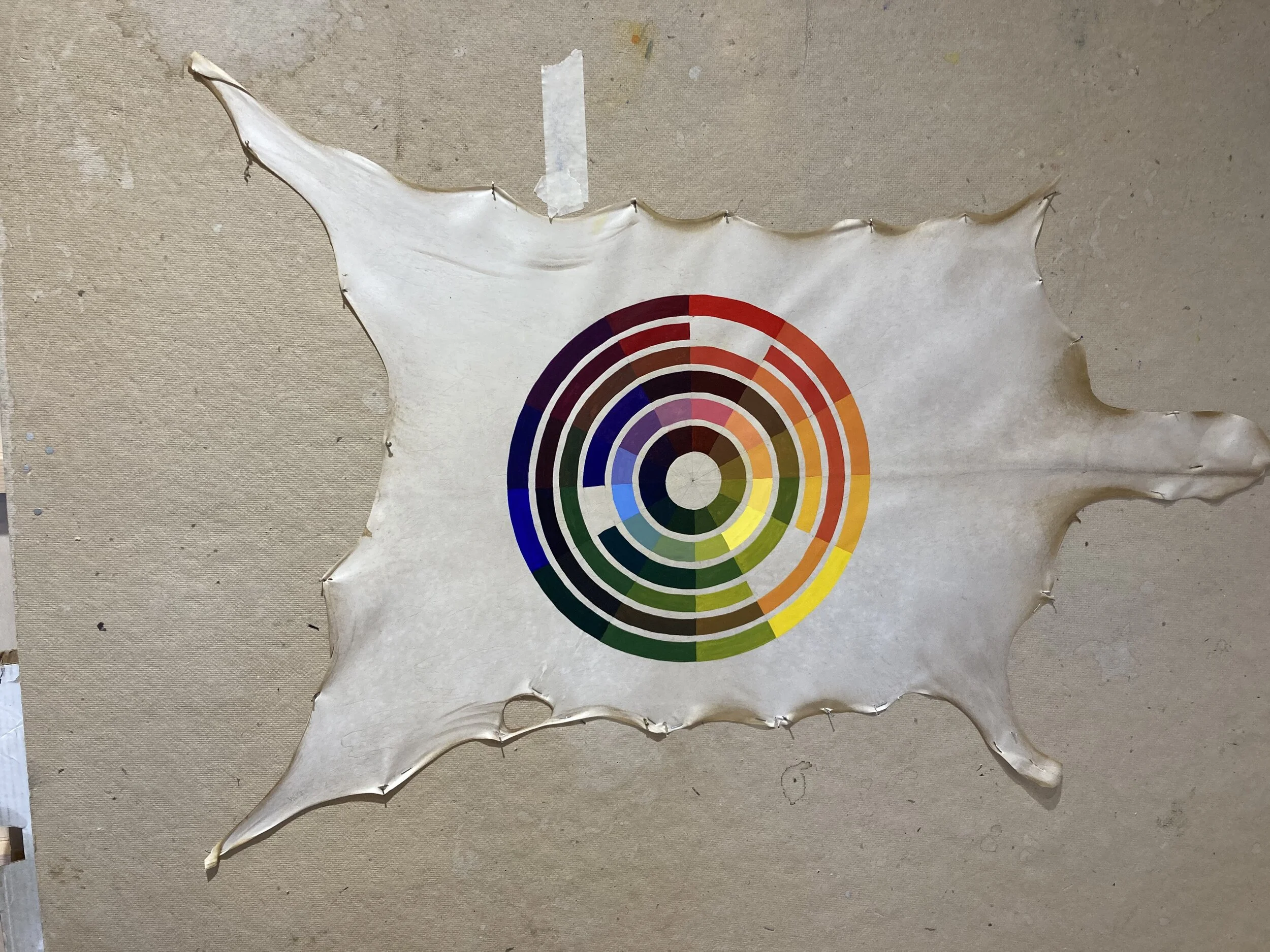
So long as I’m doing a material test with egg-tempera on parchment, I though I might as well do a color theory exercise.

EGG YOLK MEDIUM

First I reached out to local grocery stores to see if I could acquire any recently expired eggs. I found that larger food chain grocery stores were strongly against the idea due to store policy of not giving away expired refrigerated items. Then I tried a small “mom and pop” grocery store and met a really kind woman who was happy to give me eggs and excited to hear about the project. Later I read, however that you want fresh eggs because you want the embryo of the egg to be strong enough that you can pinch it and drain the yolk out of the sack. You then discard the sack.

Its important to wear a mask when mixing pigments. Especially toxic pigments! Eye protection is also a good idea. You can find clear glasses for indoors.

Its important to wear a mask when mixing pigments. Especially toxic pigments! Eye protection is also a good idea. You can find clear glasses for indoors.

MIXING PIGMENTS

Some pigments want to mix with water better than others, so mixing at the bottom of a cup is a great way to trap the pigment and the water into a tight space for integration. First I introduced the yellow, red, blue, violet, white, and charcoal pigments to a little water to create a paste. From these I mixed the various other colors on the outer edge of the color wheel (i.e yellow-orange, blue violet, etc). I stored all of these colors in recycled plastic containers from take out meals. “In egg tempera, the critical ratio is the amount of egg yolk to pigment. That ratio is, more or less, one part yolk to one part pigment, regardless of how much water has been added to either your medium or pigment paste.” (Koo Schadler)

mixing paint with water.jpg

COLOR THEORY

While visiting NYC this past week to drop off a painting, I met up with my old gilding mentor/boss of 5 years, Bill Gauthier (@gilding_nyc). He is a materials specialist and inspired me to return to “the fundamentals” to improve the integrity of my painting practice. Color theory was one of the things we discussed in depth (along with anatomy and life drawing). Bill stressed the importance of knowing color so well that you can, for instance, mix any color using only three basic colors to get there. “Basic” being ultramarine blue, cadmium red, yellow, magnesium violet, white, or black. He suggested that I re-create a full color wheel on using ONLY these colors.

Sustainability & the Art Studio

screen-shot-2021-07-09-at-7-38-43-pm_orig.png

I am currently participating in Ivan Asin’s 5 week class Sustainability and the Studio through the Center of Art Education and Sustainability (CAES, sustainableartschool.org). Ivan walked us through sustainability as a standalone concept (i.e. meeting our own needs without compromising the ability of future generations to meet their own needs). I appreciate the sentiment to think ahead, it reminds me of the Great Law of the Iroquois- to think seven generations ahead. This is not the culture I was born into, however. I am a European-American who grew up just outside of New York City in the suburbs of New Jersey surrounded by an industrial landscape. I learned to make art in classes with acrylic tempera paint in plastic cups using “disposable” brushes. All of this would get washed out in the sink (entering into the water system) or thrown out in the trash (heading straight to a landfill). This is still going on in most schools around the country (and I suspect in most first world nations). How did we become so disconnected from the materials we are using as artists and art educators? This seems to parallel a tech-influenced disconnection from each-other and sense of community, as well as a disconnection from sense of place and the non-human world.

I am fascinated by the different relationships to art materials throughout the renaissance, industrial and modern eras (and the psycho-social-spiritual shifts therein). In class we reviewed the historical background of the function of art and critiqued the emphasis on individualism in the modern era (see Suzi Gablik: the Reenchantment of Art).  As Ivan notes, artists produced their own materials until industrialization. In the 20th century art, nature, and science drifted apart. Now largely estranged from art making processes in the post-industrial world, some artists return to the work of earlier eras (such as the renaissance) wherein artists were making their own materials. A renowned reference for such processes can be found in Cennino Cennini’s book Il Libro Dell’Arte (written around the turn of the 15th century). There are many cultures all around the world, of course, who have long been and still do make art within their means; connective to the land and culture.


Class Project

Ivan has tasked us to take up a class project of our choosing over the next couple of weeks. He has generously supplied us with a plethora of resources on painting & inks, natural dyes, canvas & grounds, brushes, pencils & drawing, paper making, glues & adhesives, book arts, and ceramics. I have dabbled in making my own paints, inks, dyes, charcoal, glues, gessoes/canvases, and sketchbooks before. But I have not formally gathered my documentation and written about some of these experiments. This is one idea I have for my project. My ultimate ambition within and outside of my own art practice is to provide inspiration and support around sustainable approaches to artmaking. It would be a great exercise to demonstrate and share what I have learned. An alternative idea for my project for this class is more hands on: material testing with parchment (animal hide) for future formal artworks. I have never worked on parchment^1 before, so there is much to encounter. I would like to explore stretching/framing the parchment^2 and experimenting with egg tempera^3, oak gall ink^4, and/or a Cennini gesso recipe^5 for gilding. I am quite grateful to Ivan’s emphasis on building alliances and connections within your community to trade and acquire materials. This is exactly what can help shift me/us from an individual approach to art making toward a communal endeavor. I will be seeking connections from here-out.


1.     I have recently acquired a piece of parchment from Pergamena (pergamena.net) in upstate New York. As a meat eater, I am intentionally choosing to work on parchment (animal hide) as a means of reconnecting with ancient processes and the typically discarded parts of the animal whose life is taken for meat. I am dismayed that this hide is not from an animal I have been in relationship with, but rather has been collected by Pergamena from slaughter houses that distribute hides as a byproduct of the meat industry. In the future I would like to learn how to hunt and process the animal hide myself. But this is no small undertaking and I will need to find the right mentor who has a deeply respectful approach. I have many thoughts and feeling about how disconnected we are from our food sources but I will save those for another post at the time I more seriously approach parchment as a medium.

2.     To building a frame to stretch it for display I am going to reach out to a family friend who is a wood worker. I will have to do more research on the right string or clips to use.

3.     I am familiar with the process of egg-tempera (though it has been a while) which involves egg yolk and powdered pigment. I would like to reach out to local grocery stores to see if I can acquire recently expired eggs. I am quite grateful to Ivan’s emphasis on building alliances and connections within your community to trade and acquire materials. As for the pigment, I have a library of powdered pigments from Kremer pigments in NYC as well as many pigments that were passed down to me from a deceased family friend.

4.     The oak gall ink comes from a recipe I learned from the artist-educator Caroline Ross (@foundandground), which I have made before though it is starting to mold so I will have to look into why this is happening and whether I can still use this ink.

5.     As for the gilding, I will need to create an old gesso recipe from Cennini which involves plaster of Paris (gypsum? I can either get this at blick or try to use some chalk from Bologna that I have), white lead (though I may be able to get away with marble dust that I have) sugar (or honey), and egg white glair. Red clay or pigment is often added though not necessary. Gold is then applied to this gesso on the parchment. I spent 4-5 years working with a gilder, Bill Gauthier in New York city and whenever we did large jobs I would save the scraps of gold and collect them. Bill saved most of his extra metal leaf from projects and gifted me several books upon my departure from NYC. While he was an incredible mentor who was devout to his craft, I ultimately left this industry because the extraction and distribution of gold is a dark story. I am subsequently fascinated with our symbolic and material relationship to gold and would like to learn more about its extraction and distribution.

Heres a pic I took at Pergamena when I was in upstate New York last month. There are stretched hides in the parchment workshop area. (Pergamena.net)

Heres a pic I took at Pergamena when I was in upstate New York last month. There are stretched hides in the parchment workshop area. (Pergamena.net)

ECO-ART-EDU

ECO-ART-EDU

Welcome!

I am starting a blog to document my adventures in wild-crafting art materials. I have been painting for nearly 15 years and have undergone formal and informal training in the arts. After studying at the Rhode Island School of Design and working for various artists and artisans in New York City, I came to understand how unsustainable common approaches to art making in America are. Simultaneously, I began to practice medicinal herbalism and encounter a variety of artists taking up wild-crafting (such as Nick Neddo and Caroline Ross). I became fascinated with our relationship to materials.

I am writing to you from North America (turtle island). It is my observation that prior generations fixated on growth and accumulation, yet today many youth (i.e Greta Thunberg) are fixated on sustainability and responsibility as we contend with the impacts of the Great Acceleration amidst a destabilizing socio-ecological context. Nearly every field of research and practice is beginning to critically evaluate the consequences of our actions and look for sustainable and just approaches to their practice. The field of art and art education is no different. I have come across many poignant theorists and practitioners campaigning for the necessity of socio-ecological approaches to the arts and art education in this perplexing time. 

My passion as an artist-educator lies in the intersection of fine-arts, the healing arts, and ecology. After years of apprenticeship, practice, and reflection within these contexts, I am enthusiastically honing in on the emerging field of Eco-Art-Edu.  While I am still feeling for the potentials there-in, critically evaluating our relationship to materials as artists and educators is a great place to start. What does it suggest to a child that we are encouraging them to express themselves using plastic, non-recyclable materials that are often meant to be used once and thrown away? Many art teachers I have spoken with feel disempowered because they do not have the financial and bureaucratic support to imagine or pursue another route. I have witnessed through my personal practice as an artist and educator as well as through the observation of others that the endeavor of making art materials has the capacity to empower us, ground us, orient us, and widen our anthropocentric perspective. It also increases accessibility in contexts where budget for art materials restricts programming. 

I am led to believe that this is a relevant and significant topic to a wide range of art practitioners (from artists to educators) and has the potential to be woven together with science, ecology, and social science curriculums. My goal for this blog is to document my materials research and brainstorm adaptable curriculum for artists and educators.

Cheers!

Anna